
Optimising Offshore Cathodic Protection Retrofit with PFG Survey & 3D Simulation
Extending the operational life of offshore structures requires assurance that the existing cathodic protection (CP) system can continue to provide adequate corrosion protection. Conventional retrofit designs are typically based on conservative calculations and industry standards, which often result in higher-than-necessary sacrificial anode requirements.
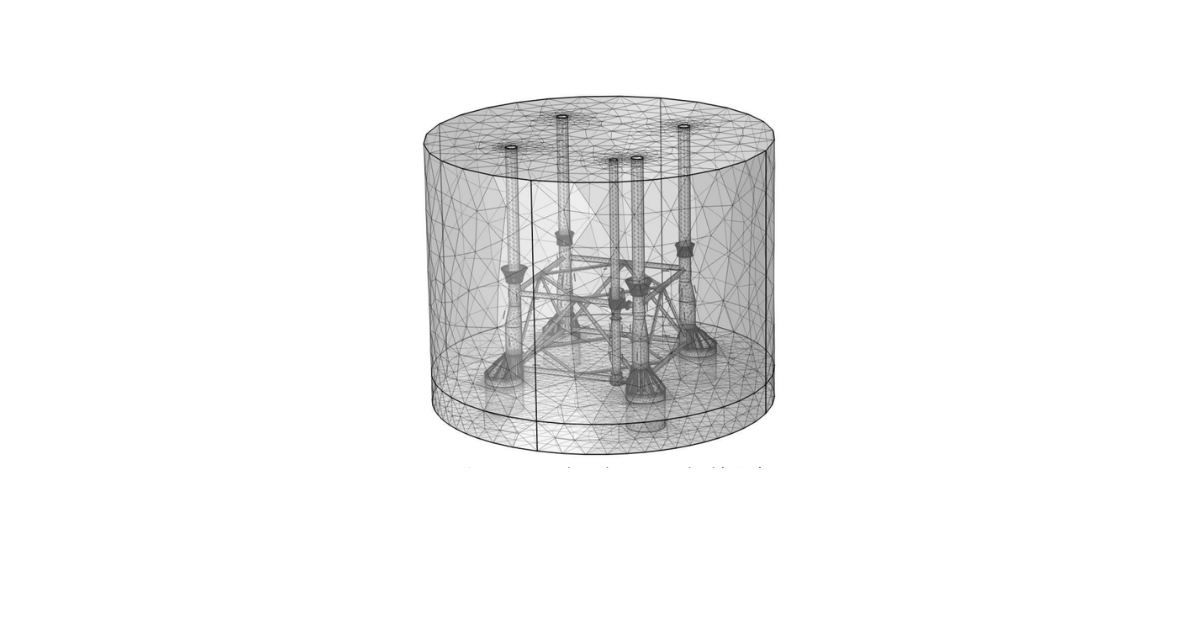
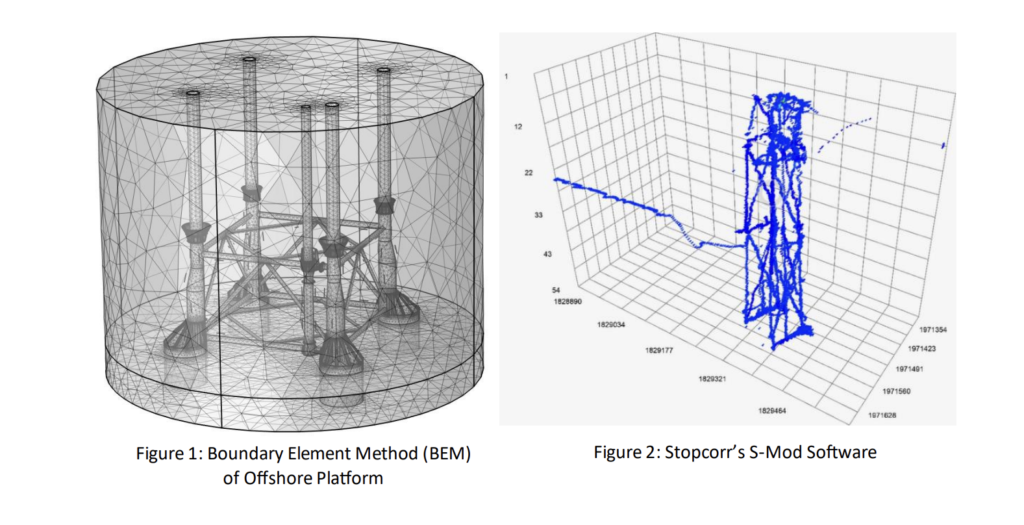
Stopcorr Services integrates Cathodic Protection and Field Gradient (PFG) Survey, 3D Field Gradient Software (S-Mod), and 3D Cathodic Protection Simulation to deliver a more accurate and optimised retrofit design. As-found inspection data were processed using S-Mod Software and used to construct a three-dimensional numerical model. This model evaluates the actual condition of the CP system, predicts its remaining service life, and optimises the retrofit solution based on real field conditions rather than conservative assumptions.
Project Highlights
• Conducted a comprehensive PFG Survey to collect as-found cathodic protection data, including structure potentials, electric field gradients, seawater conductivity, and sacrificial anode condition.
• Processed and analysed the survey data using Stopcorr’s S-Mod Software to generate high-quality input for the simulation model.
• Developed a detailed 3D electrochemical model incorporating structural geometry, seawater properties, steel polarisation characteristics, and sacrificial anode behaviour.
• Predicted the remaining performance of the existing CP system and identified the optimal timing for retrofit.
• Compared retrofit designs derived from conventional calculations and numerical simulation to optimise anode requirements.
Results
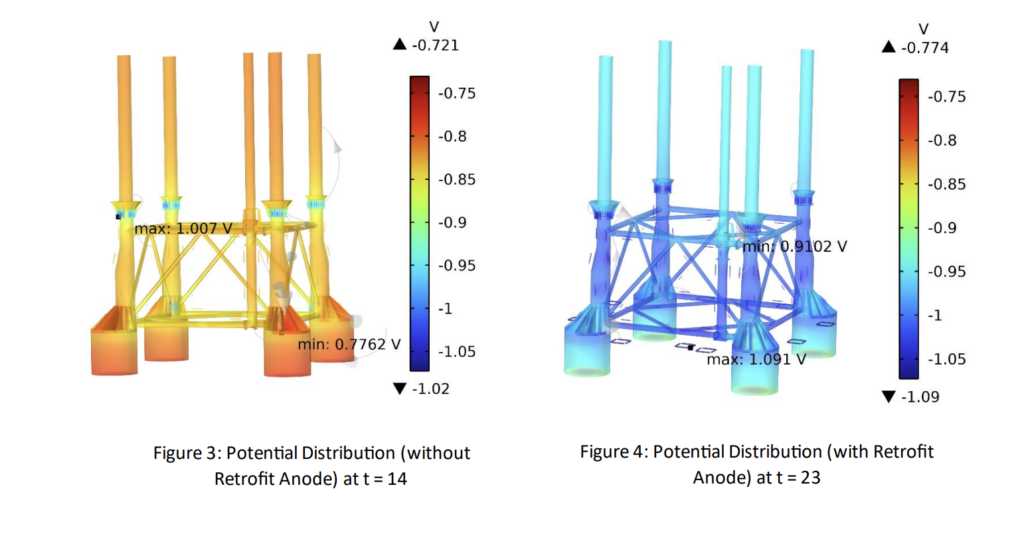
The simulation predicted that the existing sacrificial anode system would continue to provide effective protection for approximately 13 additional years. The optimized retrofit system, when installed at t = 13, is projected to extend the platform’s CP system life by a further 10 years, up to t = 23. Using the integrated PFG Survey and 3D Simulation approach, the retrofit design required only 40 sacrificial anodes, compared with 135 anodes estimated using the conventional design method, while still satisfying the required protection criteria across the platform. This significantly reduced material requirements and demonstrated the value of simulation-based optimisation.